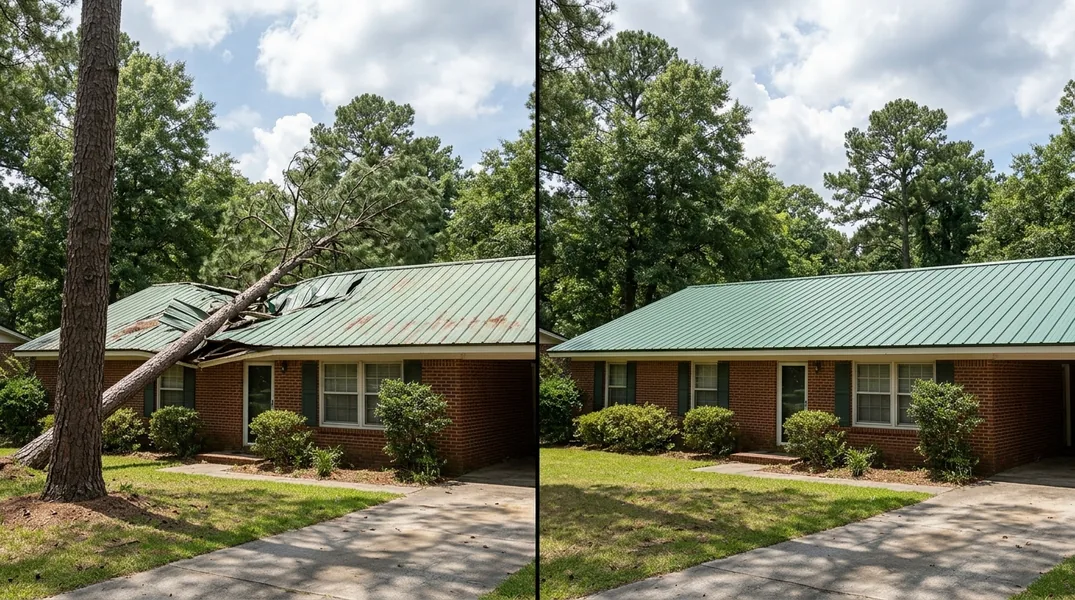
Why Storm Season Hits the Midlands Harder Than You Think
When people hear the phrase "storm roof South Carolina," they often picture the coast. But homeowners in the Midlands know that severe weather does not stop at the fall line. Columbia sits far enough inland to avoid most hurricane landfalls, yet it regularly absorbs the outer bands of tropical systems, and it sits squarely in a region that produces intense afternoon thunderstorms from May through September. Those storms bring straight-line winds that can exceed 60 mph, plus hail and driving rain that find every weak point in a roof.
The practical question for a homeowner is not whether a storm will come, but whether the roof above your head is built to take it. Asphalt shingles are the default across the Midlands, and while they perform reasonably well in ordinary weather, they have a documented tendency to lift, crease, and tear when wind gets underneath them. That is why more homeowners in Columbia are asking about metal, and specifically about how metal roofs are rated for wind. Understanding those ratings is the first step toward making a decision you will not regret after the next big front rolls through.
What a Wind Rating Actually Means on a Metal Roof
A wind rating is not a single number pulled from thin air. It comes from standardized testing, most commonly the ASTM E1592 and UL 580 protocols, which simulate how a roof assembly behaves when wind creates suction (negative pressure) over the surface. The test measures uplift, the force trying to peel the roof upward and off the deck. A metal roof that passes at a given rating has been proven, as an assembled system, to resist that uplift up to a stated pressure.
This matters because wind does not simply push on a roof. It accelerates over the ridge and creates a low-pressure zone that literally sucks the covering upward, which is why so many shingle roofs fail at the edges and ridge first. A Standing Seam Metal Roofing system, with concealed fasteners and interlocking panels, distributes that uplift across the entire panel rather than concentrating it at a few nails. When you see a metal roof advertised as wind rated, the manufacturer is usually stating that the panel and attachment method passed testing at a specific design pressure, often expressed in pounds per square inch. The number itself is less important than the fact that the whole system was tested together.
Hurricane Ratings, Uplift, and the Numbers Homeowners Should Know
You will sometimes hear a metal roof described as a metal roof hurricane product, and that language comes from the fact that many standing seam panels are tested to resist uplift pressures associated with high-wind zones. In Florida and coastal South Carolina, building codes require specific product approvals, and those same panels are available here in the Midlands. A common benchmark is a design pressure rating of around 50 to 100 pounds per square foot, depending on panel profile, gauge, and fastener spacing. For most Midlands homes, a properly installed standing seam roof will exceed the wind loads the local code expects.
What homeowners should take away is that the rating is only as good as the installation behind it. A panel rated for 100 psf means nothing if it is fastened to a deck that is rotting or if the clips are spaced too far apart. This is why a Metal Roof Installation should always begin with an honest inspection of the decking and framing. When we assess a roof in Forest Acres or anywhere in the Midlands, we look at the sheathing, the attachment schedule, and the roof geometry before we ever talk about panel choice. The wind rating on the brochure is a ceiling, and the installation determines whether your home actually reaches it.
How Metal Roof Wind Resistance Compares to Shingles and Tile
Metal roof wind resistance stands out for a few practical reasons. First, the panels are continuous from eave to ridge in most installations, so there are fewer seams for wind to exploit. Second, standing seam systems use concealed fasteners, meaning there are no exposed nail heads to back out or washers to fail. Third, metal is lighter than tile and far more dimensionally stable than asphalt, so it does not become brittle after years of sun exposure. A shingle that has baked through fifteen Carolina summers is a very different product than the one that left the factory.
That does not mean every metal roof is equal. Exposed-fastener panels, often called screw-down panels, are common on agricultural buildings and some residential retrofits, and they rely on rubber washers that can degrade over time. They are still strong, but they require periodic inspection of the fasteners. Standing seam is the better long-term choice for a home you plan to keep. If you are weighing options for a Metal Roof Replacement, it is worth asking specifically which panel profile and which attachment method the contractor intends to use, and why. A good installer will explain the trade-offs rather than push the most expensive option.
Retrofit, Codes, and What Storm Season Means for Your Timeline
Many Midlands homeowners are not ready for a full tear-off, and that is where Metal Roof Over Shingles (Retrofit) becomes relevant. A retrofit can be a sound choice when the existing shingles are flat and the deck is solid, but it changes the wind profile of the assembly. The new metal sits higher, and the attachment must reach through the old roof into the structural deck. A contractor who understands wind ratings will account for that in the fastening schedule rather than treating the retrofit as a cosmetic cover-up. If the existing roof is already curling or has soft spots, a tear-off is usually the safer path.
Timing matters too. Storm season in the Midlands runs roughly from late spring through early fall, and roofing schedules fill up fast once the first round of hail damage hits. If you are considering a metal roof before the next season, the smart move is to get an assessment now rather than after a storm. You can reach Columbia Metal Roofing at (803) 353-5064 to talk through your situation, or request a free estimate and we will walk your roof and explain what the wind ratings mean for your specific home. Homeowners in Blythewood and Arcadia Lakes ask us the same question every spring, and the answer always starts with the deck, not the panel.
Metal Roof Installation Near Me: Choosing a Contractor Who Understands Wind
When you search for metal roof installation near me, you will find no shortage of contractors. The differentiator is whether they can explain wind ratings in plain language and show you how their installation method meets them. Ask for the manufacturer's published test data, ask how clips or fasteners are spaced, and ask what happens at the perimeter and ridge, where uplift is highest. A contractor who cannot answer those questions is not the right fit for a storm-rated roof, no matter how attractive the bid looks.
It is also worth discussing pricing early, because wind-rated systems vary in cost based on panel gauge, profile, and the condition of your deck. A transparent contractor will separate the base installation from any decking repairs so you can see exactly what you are paying for. Columbia Metal Roofing serves the Midlands with installations built around real wind performance, not marketing claims. If you want a roof that is ready for the next front, call (803) 353-5064 and let us show you what a properly rated metal roof looks like on a home like yours.
Looking for a professional metal roofing contractor in Columbia? Columbia Metal Roofing responds fast for all your metal roofing needs.
Get a Free QuoteOur services: Metal Roof Installation · Standing Seam Metal Roofing · Metal Roof Replacement